- Your cart is empty
- Continue Shopping


How Long Do Physical Anxiety Symptoms Usually Last?
- All meds
- Posted on
-
by @zohaib@007_123@
- 0 comments
It is one of the most frightening aspects of dealing with anxiety: your heart starts pounding against your ribs, your chest feels tight, your hands begin to tingle, or a sudden wave of nausea hits your stomach. Even if you recognize that you are feeling anxious mentally, the physical intensity of these symptoms can make you panic: How long is my body going to feel like this? Is this ever going to stop?
The duration of physical anxiety symptoms depends on whether you are experiencing an acute surge of adrenaline (like a panic attack), recovering from an adrenaline crash, or living with chronic background stress.
Here is a guide to how long physical anxiety symptoms typically last, why your body responds the way it does, and how to help your nervous system return to a calm baseline.
The 3 Timelines of Physical Anxiety Symptoms
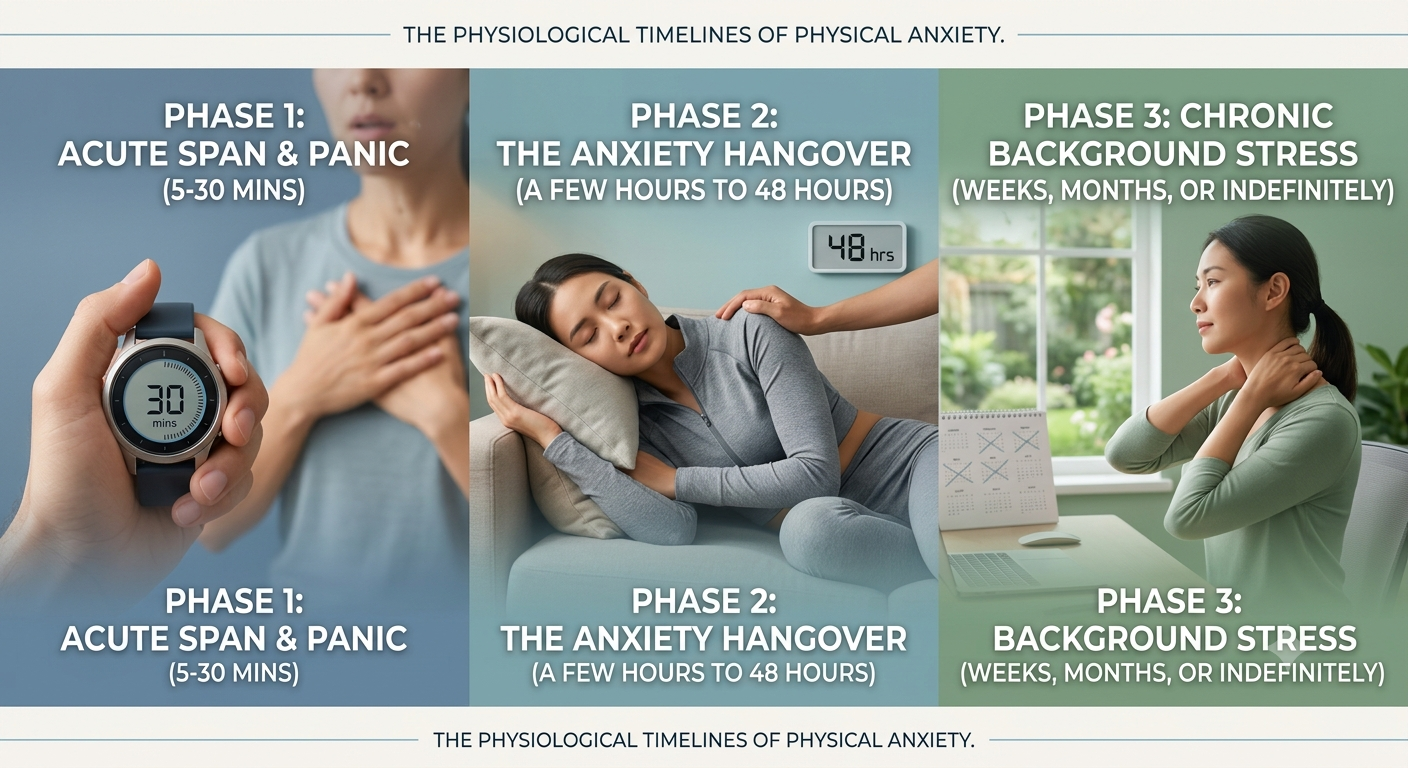
To understand how long your symptoms will persist, it helps to categorize anxiety into three distinct physical phases:
┌─────────────────────────────────────────────────────────┐
│ PHASE 1: Acute Panic / Adrenaline Spike                 │
│ Duration: 5 to 30 Minutes                               │
└───────────────────────────┬─────────────────────────────┘
                            │
                            ▼
┌─────────────────────────────────────────────────────────┐
│ PHASE 2: The "Anxiety Hangover"                         │
│ Duration: A Few Hours to 48 Hours                       │
└───────────────────────────┬─────────────────────────────┘
                            │
                            ▼
┌─────────────────────────────────────────────────────────┐
│ PHASE 3: Chronic Background Anxiety                     │
│ Duration: Weeks, Months, or Indefinitely (if unmanaged) │
└─────────────────────────────────────────────────────────┘
1. Acute Spikes & Panic Attacks (5 to 30 Minutes)
- Typical Duration: Peaks within 10 minutes and usually resolves within 20 to 30 minutes.
- Common Symptoms: Racing or pounding heart (palpitations), hyperventilation, sharp chest tightness, dizziness, trembling, and cold sweats.
- The Biological Cause: This is your body’s survival fight-or-flight mechanism firing on all cylinders. Your adrenal glands dump epinephrine (adrenaline) into your bloodstream to prepare you to fight or flee a threat. Because your body cannot physically sustain a maximum adrenaline surge indefinitely, the acute spike naturally subsides as your liver and kidneys metabolize the stress hormones.
2. The “Anxiety Hangover” (A Few Hours to 48 Hours)
- Typical Duration: 2 to 48 hours following a severe panic episode or high-stress day.
- Common Symptoms: Deep physical fatigue, heavy limbs, tension headaches, brain fog, and muscle soreness.
- The Biological Cause: An acute adrenaline spike drains your body’s glycogen (stored glucose) reserves and leaves your muscles fatigued from sudden, intense tension. Once the panic subsides, you experience a physical “crash” while your body restores its chemical balance.
3. Chronic Background Stress & GAD (Weeks to Months)
- Typical Duration: Persists daily for weeks, months, or years if left unmanaged.
- Common Symptoms: Continuous muscle tightness (especially shoulders, neck, and jaw), churning stomach or IBS-like digestive issues, difficulty sleeping, constant fatigue, and shallow breathing.
- The Biological Cause: If you live with Generalised Anxiety Disorder (GAD) or ongoing life stress, your baseline cortisol levels stay constantly elevated. Because your sympathetic nervous system never fully switches off, physical tension accumulates over time.
Symptom-by-Symptom Breakdown
Different physical symptoms fade at different speeds depending on how deeply they interact with your autonomic nervous system.
| Physical Symptom | Typical Duration | Why It Happens |
| Heart Palpitations & Racing Pulse | 5 – 30 minutes | Adrenaline speeds up heart rate to pump oxygen to major muscles. |
| Dizziness & Tingling Fingers/Lips | 10 – 40 minutes | Rapid breathing lowers carbon dioxide levels, slightly narrowing blood vessels in the brain. |
| Anxious Stomach & Nausea | 1 hour – several days | The “gut-brain axis” diverts blood away from digestion toward survival muscles. |
| Chest Tightness & Sore Ribs | 30 minutes – 24 hours | Intercostal muscles brace during panic, causing lingering muscular ache. |
| Muscle Tension & Jaw Clenching | Days to months | Subconscious, continuous muscular guarding during ongoing stress. |
Why Do Physical Symptoms Last Longer for Some People?
If you notice that your physical symptoms linger long after the initial anxious thought has passed, several physiological loops may be at play:
1. The “Fear-of-the-Symptom” Loop
This is the most common reason physical anxiety persists. When adrenaline causes a sudden chest flutter or stomach churn, your brain misinterprets that physical sensation as a medical emergency. That fearful thought triggers a secondary surge of adrenaline, restarting the clock on your physical symptoms.
2. Muscle Memory & Bracing
When you are anxious, you hold your shoulders high, tighten your core, and clench your jaw. Over hours or days, this continuous isometric strain leads to physical pain and inflammation, which your brain then registers as a physical threat, perpetuating the stress response.
3. Sleep Deprivation & Fatigue
Anxiety frequently disrupts deep REM and slow-wave sleep. Lacking restorative sleep keeps your sympathetic nervous system hyper-reactive, making you significantly more prone to lingering physical symptoms the following day.
4 Steps to Shorten Physical Anxiety Symptoms
To help your nervous system return to a calm state faster, you need to send direct biological signals to your vagus nerve—the main nerve of your parasympathetic (“rest and digest”) system.
1.1. Lengthen Your Exhale (The 4-7-8 Technique):Actionable in 60 seconds.
Hyperventilation keeps adrenaline flowing. Inhale slowly through your nose for 4 seconds, hold for 7 seconds, and exhale smoothly through your mouth for 8 seconds. Making your exhale longer than your inhale forces your heart rate to slow down.
2.2. Unclench and Drop Your Shoulders:2 to 5 minutes.
Scans show that muscle release triggers brain relaxation. Consciously drop your shoulders down, un-press your tongue from the roof of your mouth, unlock your jaw, and let your stomach soft-expand.
3.3. Re-anchor Your Senses (5-4-3-2-1 Method):3 to 5 minutes.
Interrupt the body-scanning cycle by naming 5 things you can see, 4 things you can feel, 3 things you can hear, 2 things you can smell, and 1 thing you can taste.
4.4. Rehydrate & Replenish Electrolytes:Ongoing recovery.
Anxiety causes sweating and rapid respiration, leading to mild dehydration that worsens lightheadedness. Sip cool water slowly to help settle stomach cramps and restore fluid balance.
