- Your cart is empty
- Continue Shopping


Why Does Anxiety Cause Brain Fog & Derealization? Causes & Relief
- All meds
- Posted on
-
by @zohaib@007_123@
- 0 comments
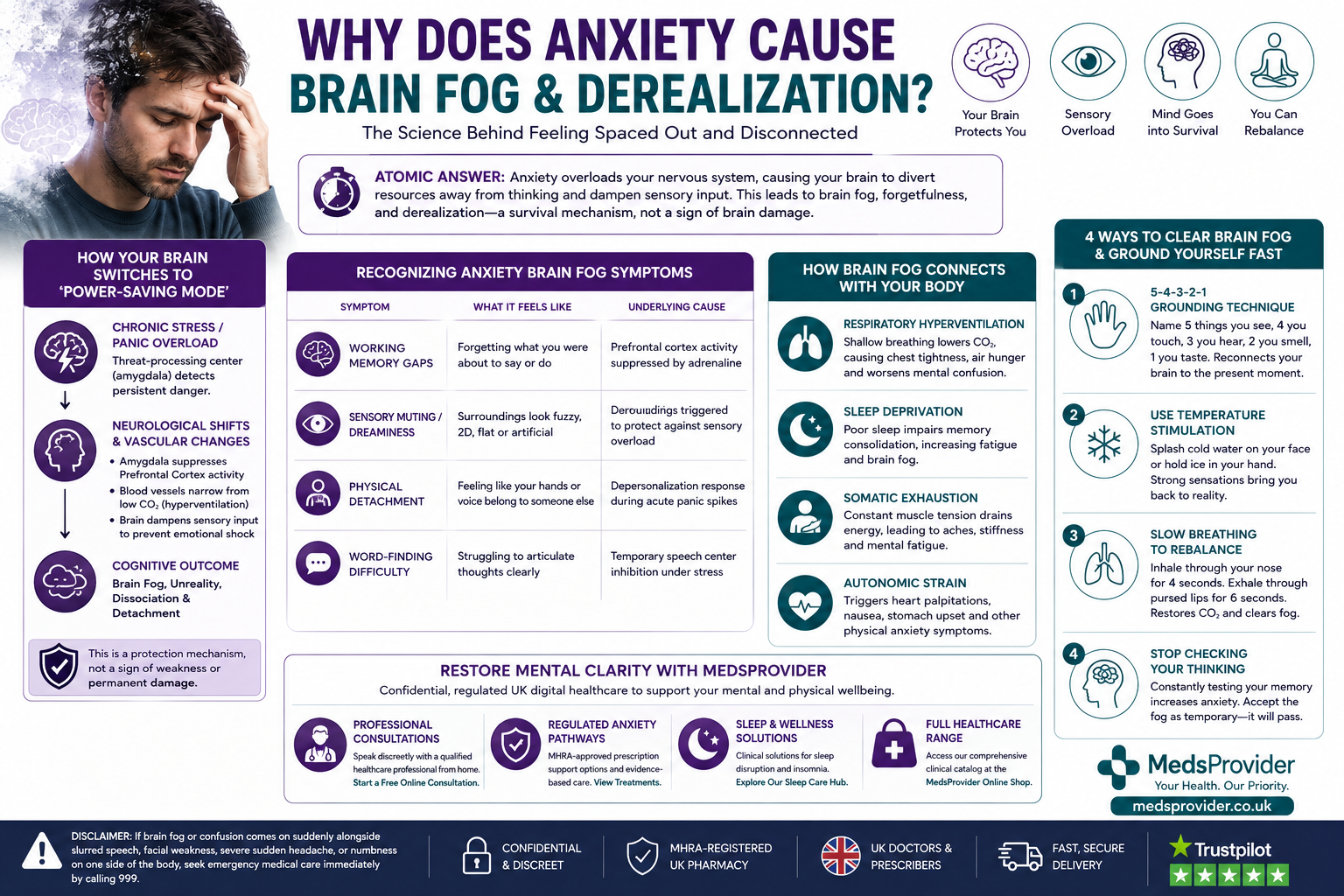
You are halfway through a conversation, sitting in a meeting, or driving down a familiar road when suddenly your mind goes blank. Everything feels strangely muted, as if you are observing the world through a thick pane of glass or living inside a dream. You might struggle to recall basic words, feel detached from your own body, or panic that you are losing your mind.
If you have ever asked yourself why does anxiety cause brain fog or derealization, you are experiencing one of the most frightening cognitive self-defense mechanisms of the human brain.
Because feeling “spaced out” or disconnected makes people worry about neurological issues or memory loss, health anxiety often surges—creating a loop where cognitive confusion feeds emotional panic. Understanding why your brain deliberately dials down sensory processing during high stress is the key to clearing the mental mist and restoring mental clarity.
1. The Science: Why Your Brain Switches to “Power-Saving Mode“
Anxiety-induced brain fog and derealization are not signs of brain damage—they are active neurological survival strategies governed by your central nervous system.
When your brain is inundated by persistent stress, financial worry, or acute panic, the threat-processing center (the amygdala) overrides your executive thinking center (the prefrontal cortex).
┌─────────────────────────────────────────────────────────┐
│ CHRONIC STRESS / PANIC OVERLOAD                         │
└───────────────────────────┬─────────────────────────────┘
                            │
                            ▼
┌─────────────────────────────────────────────────────────┐
│ NEUROLOGICAL SHIFTS & VASCULAR DIVERSIFICATION          │
│ • Amygdala suppresses Prefrontal Cortex activity        │
│ • Blood vessels narrow slightly due to low CO2 (Hyperventilation) │
│ • Brain dampens sensory input to prevent emotional shock│
└───────────────────────────┬─────────────────────────────┘
                            │
                            ▼
┌─────────────────────────────────────────────────────────┐
│ COGNITIVE OUTCOME: Brain Fog, Unreality & Dissociation  │
└───────────────────────────┴─────────────────────────────┘
A. Prefrontal Cortex Suppression
Your prefrontal cortex handles working memory, complex decision-making, concentration, and language retrieval. During fight-or-flight activation, your brain diverts electrical activity and glucose away from this high-level thinking center toward primitive survival regions. This rapid shift leaves you feeling forgetful, slow, and unfocused.
B. Derealization and Depersonalization as Defense Mechanisms
- Derealization (DR): The external world feels surreal, flat, dreamlike, or artificial.
- Depersonalization (DP): You feel detached from your own physical body, thoughts, or voice.
These dissociative states occur when extreme adrenaline levels overload your sensory processing systems. To protect you from emotional shock or severe trauma, your nervous system dampens sensory perception—acting as a psychological buffer against overwhelming fear.
C. The Role of Oxygen and Carbon Dioxide
Rapid, shallow chest breathing during panic lowers carbon dioxide levels in your blood. This causes mild cerebral vasoconstriction (temporary narrowing of small blood vessels in the brain), which directly contributes to feelings of mental heaviness, confusion, and anxiety-induced dizziness.
2. Recognizing Anxiety Brain Fog Symptoms
Cognitive symptoms of anxiety can manifest in several distinct ways:
| Symptom | Cognitive & Physical Experience | Underlying Cause |
| Working Memory Gaps | Forgetting what you were about to say or do | Prefrontal cortex activity suppressed by adrenaline |
| Sensory Muting / Dreaminess | Surroundings look fuzzy, 2D, or artificial | Derealization triggered to protect against sensory overload |
| Physical Detachment | Feeling like your hands or voice belong to someone else | Depersonalization response during acute panic spikes |
| Word-Finding Difficulty | Struggling to articulate thoughts clearly | Temporary speech center inhibition under stress |
3. How Brain Fog Connects with Other Physical Symptoms
Brain fog rarely occurs in isolation because the autonomic nervous system impacts your entire body simultaneously:
- Respiratory Hyperventilation: Shallow breathing during panic alters blood gases, aggravating chest tightness and air hunger while worsening mental confusion.
- Sleep Deprivation: Inability to achieve deep restorative sleep directly impairs memory consolidation, compounding anxiety sleep problems and insomnia.
- Somatic Exhaustion: Constant muscle guarding leads to chronic fatigue and painful muscle tension, draining mental energy.
- Autonomic Strain: Severe panic spikes often trigger cardiovascular and gastrointestinal reactions, including racing heart palpitations, anxious stomach nausea, or sudden stress-induced diarrhea.
4. How to Clear Anxiety Brain Fog & Ground Yourself Fast
When brain fog or derealization strikes, trying to forcedly “think clearly” can increase frustration. Instead, use physical sensory grounding to signal safety to your nervous system:
1.1. Practice the 5-4-3-2-1 Grounding Technique:Immediate sensory re-anchoring (0 – 60 seconds).
Acknowledge 5 things you can see around you, 4 things you can physically touch, 3 things you can hear, 2 things you can smell, and 1 thing you can taste. Forcing your brain to process external sensory data pulls it out of internal panic loops.
2.2. Use Temperature Stimulation:1 to 2 minutes. Wash your hands or face with cold water, or hold a piece of ice in your palm. Strong temperature contrast forces your brain’s attention back to concrete physical reality.
3.3. Rebalance Blood Gases with Slow Breathing:2 to 4 minutes.
Inhale deeply through your nose for 4 seconds and exhale through pursed lips for 6 seconds. Slowing your respiration restores blood $CO_2$ levels, dilating blood vessels in the brain and lifting mental fog.
4.4. Stop Checking Your Thinking:Post-flare adjustment.
Constantly testing your memory or checking how “real” you feel increases self-monitoring anxiety. Accept the brain fog as temporary protective fatigue that will lift as stress levels settle.
Restore Mental Clarity with MedsProvider
If recurring brain fog, derealization, or persistent health anxiety are affecting your work performance, confidence, and peace of mind, getting regulated clinical support is a safe, proactive choice.
At MedsProvider, we provide confidential, fully regulated UK digital healthcare services to support your physical and emotional wellbeing:
- Professional Consultations: Speak discreetly with a qualified healthcare professional from home to evaluate panic disorders, cognitive anxiety, and stress symptoms. Start a Free Online Consultation.
- Regulated Anxiety Pathways: Learn about MHRA-approved prescription support options and evidence-based care managed by our registered UK online pharmacy network. View Regulated Anxiety Support & Treatments.
- Sleep & Wellness Solutions: Explore our clinical offerings for sleep disruption and insomnia at our Sleep Care Hub.
- Full Healthcare Range: Access our comprehensive clinical catalog at the main MedsProvider Online Shop.
Disclaimer: If brain fog or confusion comes on suddenly alongside slurred speech, facial weakness, severe sudden headache, or numbness on one side of the body, seek emergency medical care immediately by calling 999.
